
Updated in 2026 to include more sunny March days on this incredible peninsula of ice ringed by emerald waters.
On a Wednesday night in late March of 2022 I was lounging at home reading the weather, playing with the cats, and wishing I were skiing the next day when I got a text from Dana wondering if I could ski. My initial response was something like: "no thanks, I should be a good little corporate drone and go to work". Then I thought: Wait. WAIT. WWWWWAIT. Why would I put bloodthirsty corporate interests busy lining their own pockets ahead of a beautiful day in our unparalleled mountains with old friends?
The next morning, I called in sick with a bad case of powder fever, and headed for the icy tarmac of Merrill Field curious what we'd find in a rarely visited and unique zone. I found Dana preflighting his PA-12 in the numbing cold air of first light, then squirmed into the backseat of the taildragger. Feeling basically like Top Gun, I felt Dana push the throttle forward and the plane easily lift away from Anchorage.
Looking to be made of little model houses, our city disappeared behind as we climbed east towards endless wilderness. Following Ship Creek into the morning sun, we looked for the wandering tracks of the big brown bears hungry after their long winter night and ready to fill their bellies with a moose breakfast. To our right, the curved couloirs of Temptation grew from the hoar frost of the valley bottom to snake up the north face. As we approached Crow Pass and the maritime zone, the mountains continued to grow around us. To the left was the jagged south face of Organ. Some lucky and determined skiers have skied east from its summit. I'd like to join those ranks. 
There's so much country back here; it was like a giant slideshow as one mountain would slip away to reveal another behind it. As the slide of memories that is Bird Peak's steep and angular north face passed us, it revealed the shaded aquamarine jewel of Magpie.
Next up was the rimed summit of Raggedtop. There is so much to explore in our promised land that obvious options can fall out of mind for years - that's been the case for this Girdwood classic for me. Just visible on the right is the pass that we've used to avoid the avalanche and alder hazards of lower California Creek and access Fishs Breath famous southeast face and less known but equally dramatic north couloir. It would be cool to link up these two iconic peaks in one ski tour.
The shiny tin roof of Rosie's Roost is visible on the wind swept moraine bottom center:

Cresting the divide into the Prince William Sound, we entered another world. It feels like the Girdwood and Portage valleys get a lot of precipitation, but its nothing compared to the the mountains on the western side of the Sound. Like a giant catchers mitt, these piles of snow and ice are the first barrier wringing moisture out of the huge storms of the Pacific as collide they crash into Southcentral Alaska.

The sense of scale here was impossible to understand. With eyes calibrated for the 10-foot tall snow pillows we find in our usual zones, I looked down realizing I needed to rescale those to 30 feet. We circled possible ski terrain, and with this frame of reference thrown out the window my brain struggled to grasp that we were looking at laps that would drop 3,000 vertical feet to the Yale Glacier.

Dana found Jeff, Jeebs and the tracks of Cubbie the Supercub, and flared into a soft landing of fresh overnight snowfall on the Meares Glacier.

I tried to be helpful while Dana prepped to leave his plane for the day, but mostly just found myself gaping at the infinite snow of this temperate northern rainforest. Then, framed by the sapphire blue waters of college fjord, we chased Jeebs up the skintrack.

We followed Jeebs to our drop-in point on the summit of a nunatak. Below us, the Yale Glacier spilled into College Fjord before joining the wide waters of Port Wells beyond. The first pitch was easterly and solar and sported one of those challenging breakable suncrusts that makes even the best skiers look like beginners. Well, except for Dana who made it look easy.

With this crusty data point for sunny eastly aspects, we altered our course hoping to find better snow in the shade. Jeff tipped into the north facing ramps below us - much better:

Remembering the telltale signs of all those avalanches around Girdwood, we leap-frogged from one safe spot to the next as we skied towards the Yale. Stopping to take it all in, we heard the sudden thunder of two F22s as they skimmed over the ridgeline, slid sideways in banked turns, and circled us. Close enough to see the pilots looking out of their cockpits, if I hadn't before, now I really felt like I was in Top Gun.
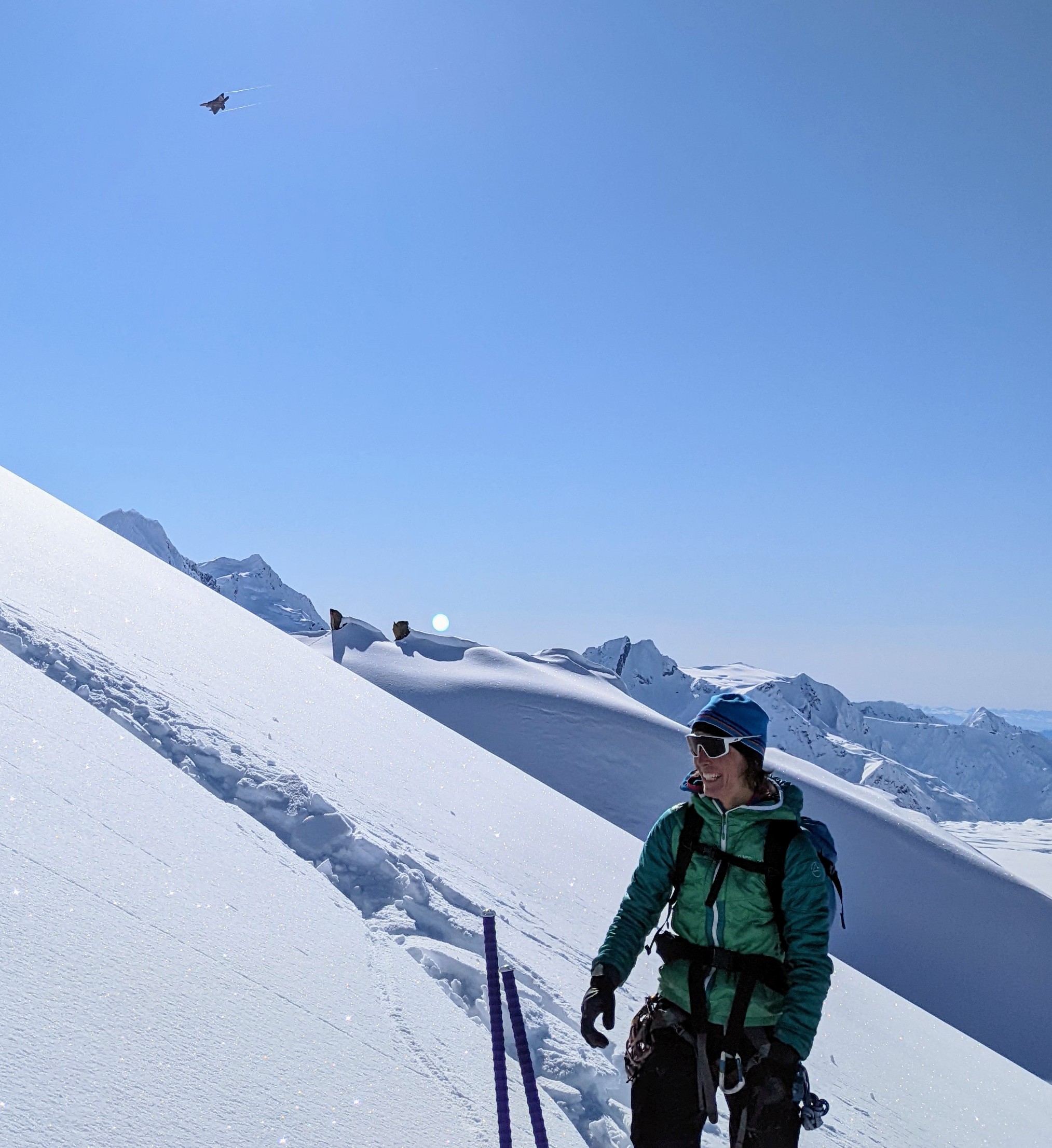
Jeff thought maybe this sudden government surveillance was his buddy "Torch" from Elmendorf and wondered if every night is date night at La Casa de Torch? Dana:

We continued to descend until we bottomed out on the Yale Glacier itself; there we put on more sunscreen and refueled in a futile attempt to keep up with Jeebs. Standing in the bottom of this gorge carved by the great river of ice, we were dwarfed by everything around us.

Then it was time to climb back out of the gorge for more.

Flowing through, over, and around the bulbous glaciated terrain, the second lap was just as gluttonous as the first.

Jeebs:

Thankful for Jeebs' hard work breaking trail through the new snow, the climb out of the abyss was faster the second time around. I was reminded of a strategy my friend Dave Bourassa uses on particularly deep days in his secret zone in Routt County - ski a half lap first - then your thrashed legs are never have to break a full lap back out of bottomless paradise.

Stuck on repeat, we ripped our skins, picked a new line, and binged on a third lap. Jeff says these feel like heliskiing laps. I've never been heliskiing, if its like this I think I might like it!

Jeebs:

9,000 vertical feet over three laps is not a normal day for me, and I was again flabbergasted by the inconceivable scale of it all as we climbed for the last time back to the runway on the Meares.

With the evening light saturating the never-ending snow and teetering blue seracs of the Dora Keen Mountains it was time to return to Dana and Jeff's planes for the flight home.

Lifting off the Meares Glacier, we skimmed between mountains made of precariously stacked piles of shear rock, fathoms of snow, and Walmart-sized blocks of ice.

Then, excited to see what views, mountains, and memories the flight home would bring, we turned into the setting sun and towards Anchorage. Leaving behind the emerald waters of the PWS, we crossed the divide to where storms drain to the Cook Inlet. There were a few in particular that I was excited to examine, like the holy cross couloir of Bounty:

The ground dropped away below us as we slipped over Benign Peak and into Peter's Creek. Dana banked his plane and we stared dumbstruck at the 3,000 foot vertical west face drenched in a purple glow.

At this moment Dane was clinging somewhere on the inky north face of Benign on his way to a sunset lap of the Malignant Couloir. Dane told me he wouldn't recommend this route to "anyone he likes".
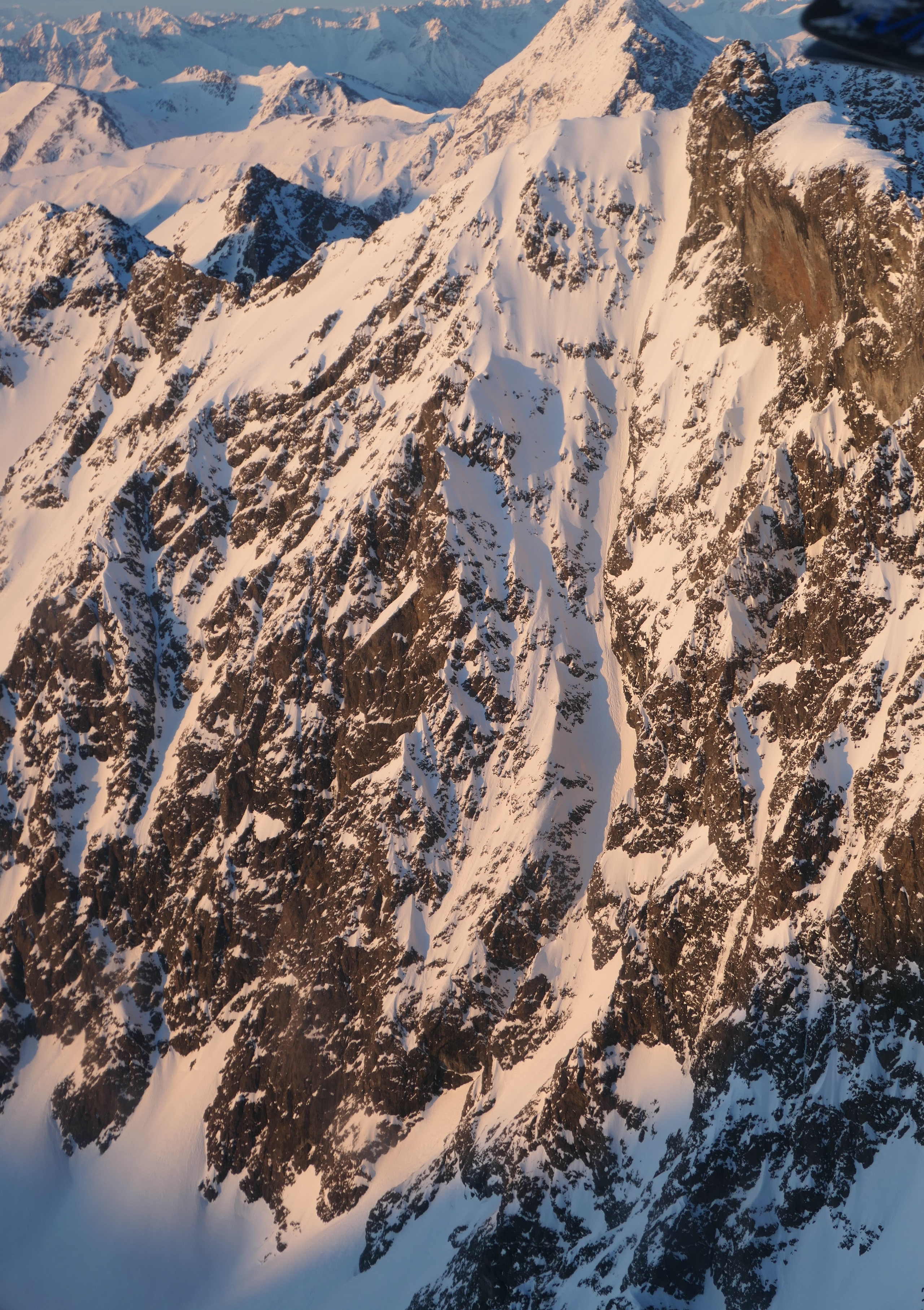
Moving on from Benign, we passed Mount Rumble like a solitary rock giant cleaving Peters Creek in half. Then, with the shadows starting to climb its flanks, we mindsurfed the spines of Peters Peak's southwest face.

Continuing towards home, we contoured around the north faces of East Killiak and its bigger, badder sister, West Killiak. There a several good options to get up and down this behemoth.

Leaving Peters Creek behind, we looked for a line down the windswept northeast face of Yukla. Another one that's still on my list - gosh that list never gets shorter.

Before I was ready to be done studying it, Yukla was gone and the ground was suddenly dropping 6,000 feet to Eagle River valley. Crossing above the frosty valley floor stuck in months of winter deep-freeze, we moved on to more leviathans. Polar Bear:

Next up, with its hanging summit spine, was Eagle Peak draped in alpenglow.

Then, with our minds trying to rolodex a day of mountains crammed through our retinas as if by firehose, we glided over the last peaks and back to our frontier city home.
March 2026 Update:
In the spring of 2026, we were lucky to return to the fat snowpack and sparkling emerald waters of the Meares Peninsula several times. February in Southcentral Alaska brought a month of evil drought and unforgiving winds that transformed our mountains into wastelands of crusts and sastrugi. All the ski addicts were searching for snow that was pleasant or, at a minimum, less hazardous for skiing.
Looking at the weather models, we began to think there might be an area of sheltered terrain in the northwestern Prince William Sound that had escaped some of the wind. With the days getting a littler longer and warmer in February, we flew east out of Anchorage. Once across the huge blue channel of Port Wells, we looked down at the snow surface under us. Emanating from the high Chugach, the higher elevation north end of the Meares Peninsula was clearly wrecked by the cold northerly outflow winds. As we worked our way south and down in elevation, we began to find snow that was at least smooth looking. Finding a sunny spot on a small glacier above Coghill Lake, we plopped down into the beautiful snow globe.

The snow seemed promising enough to try to ski.

After a few laps of poking around in powder randomly mixed with various forms of grabby breakable crust, we called it a day glad to have our ACLs intact.

Peter and I still thought there was soft snow somewhere out there on that magical peninsula of snow and ice, and wanted to keep looking. A week later, with retuned mental numerical models about where the soft snow was hiding, we went looking for mid-elevation, dead-end basins surrounded by higher terrain. At the head of the Unakwik Inlet, we found just such an amphitheater under Mount Grosvorn.

Photo: John Hermus
With the advancing tidewater front of the namesake Meares Glacier below us, John and I started with a soft lap down our pocket glacier.


Happy with what we found, we climbed and skied several small shady chutes reminiscent of the lower northern chutes of Cornbiscuit.

Photo: John Hermus


Photo: John Hermus


Photo: John Hermus

Photo: John Hermus

Stoked to have found not only seemingly stable, but also soft snow, we soaked in the evening sun before circling the terminus of the Meares Glacier on the way home. I have always wanted to see the terminus of the Meares and was blown away to see it actively bulldozing over trees as it advances forward.

The Meares is advancing despite and due to climate change. It is shaped like a vertical lollipop with most of its mass of ice at high elevations and just a little tongue draining down to the ocean. The world is getting warmer, but its also getting wetter. So much more snow is falling in the Meares' upper elevation accumulation zone that its offsetting the increased melt in its lower elevation drain pipe. Almost all glaciers on Earth are retreating; we were thunderstruck to look through this portal of what the world might have looked like going into the last ice age.

Photo: John Hermus

Photo: John Hermus
After several more weeks of bad weather and conditions, late March finally brought a period of sun to our mountains. We were ready to quest for more soft snow in this pocket of the PWS. First, we tried the long rolling runs I had skied years ago with Dana and Jeff.

Photo: John Hermus
The zone was as dramatically beautiful as always, but the snow was dust on crust. John:


Photo: John Hermus


Photo: John Hermus
But, it seemed like the lower elevation southern tip of the Meares was holding protected snow again, so Neil and I went back to find it.


Hoping to connect with Tony and his crew at Tatooine, we landed next to their camp and followed their tracks. They led us into glorious north facing runs of bowls, chutes, fins, and mini-spines covered in smooth old pow.


Spooning Tony's tracks, we lapped this awesome shady face before finishing the day with a sunny western lap above the icebergs calving from the terminus of the Yale Glacier.


Now, knowing what kind of goodies were hiding out there, Nyssa, Garth, Miles, Brady and I decided to check out Jonah Bay next. Garth and Miles:

From last month's parking lot above Coghill, we skied a quick pow lap while we waited for Brady to catch up, then dropped south into the Jonah Bay drainage and a rolly-polly corn lap.

Next up was a mellow easterly run of shallow pow, followed by a longer iteration of the same run past a cool lobe of blue ice and deeper towards the bay. Nyssa:


Nyssa:

Skiing sheltered pow past seracs was fun, and we were hungry for more, so skinned towards a longer, steeper, northerly run through another face of ice.

Garth:

Miles:

Garth:

Chris and Justin had skied several runs over here a few days ago. I wished we had more time to follow all of their tracks, but it was time to head towards one last party lap back to the parking lot.

Photo: Miles Knotek

No comments:
Post a Comment